Custom Product Fulfillment: A Buyer's Planning Guide
Understand custom product fulfillment from order approval to delivery, with practical checks for production, packing, shipping, customs, and exceptions.
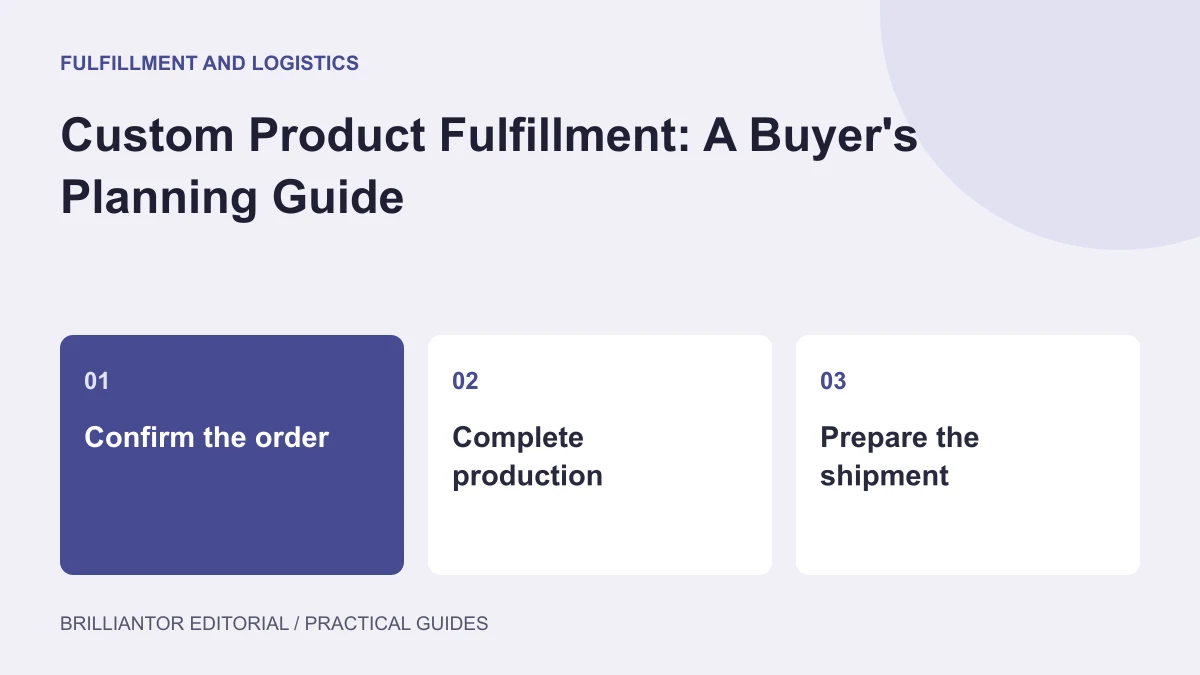
Original editorial diagram for this guide; not product inventory or a company photograph.
Custom product fulfillment is the work that turns an approved order into the right products arriving at the right destination. Depending on the arrangement, it may include receiving stock, storing it, assembling kits, picking items, packing parcels, arranging shipment, and handling delivery exceptions.
The most useful question is not simply “How long does delivery take?” Ask which steps are included, what starts each step, who owns it, and what evidence shows it is complete. That approach makes a fulfillment plan easier to understand before money and deadlines are committed.
Separate production from fulfillment
Production creates or customizes the goods. Fulfillment prepares and sends those goods to their destination. Some projects combine these activities under one arrangement, while others involve separate production, storage, and delivery teams.
Confirm the starting point of the quoted service. Does it begin when artwork is approved, when materials are available, when completed stock is received, or when a shipping order is submitted? Those are different events.
Also confirm the endpoint. A service might finish at dispatch, delivery to a receiving warehouse, or delivery to individual recipients. Do not assume that a general phrase such as “shipping included” describes every step or charge.
Map the order before choosing a delivery method
Identify each product and variant, the quantities, packaging requirements, and destination pattern. A single bulk shipment to an office has different needs from sending personalized kits to many homes.
For each line item, record the product code, variant, quantity, approved artwork reference, and any special packing instructions. For a kit, write a bill of contents that specifies exactly what belongs inside and how items should be arranged.
Choose the simplest workable fulfillment model
Bulk delivery can suit an event or workplace with staff available to receive and distribute the goods. Individual dispatch can suit remote recipients, but it requires accurate recipient data, order-level identification, and a process for exceptions.
Stored inventory can support repeated orders, but the plan should explain storage charges, stock reporting, access, aging inventory, and the process for removing remaining goods. Do not pay for a complex model unless it solves a real distribution problem.
Build a timeline with separate milestones
Use distinct stages for artwork approval, sample approval where needed, production, quality review, packing, dispatch, carrier transit, customs clearance when applicable, and final receiving. Add any required internal approvals or recipient-response deadline before those stages.
Ask what each estimate excludes. A stated production period may begin only after payment, approved artwork, and available materials. A transit estimate may begin when the carrier accepts the shipment rather than when a label is created.
Keep the required arrival date separate from an estimated dispatch date. If the event cannot move, ask when the project must switch to a simpler product, different packaging, or another agreed delivery plan. A contingency is useful only if someone has authority to activate it.
Understand the complete cost and responsibility split
Ask for a breakdown of relevant charges: goods, customization, receiving, assembly, storage, picking, packing materials, transport, insurance if applicable, customs handling, duties or taxes, and exception handling. Not every project uses every charge, but omissions should be explicit.
For international transactions, agreed Incoterms can clarify the division of delivery tasks, costs, and risks. The U.S. International Trade Administration’s guide to Incoterms also explains their limits: they do not replace all the other terms of a sales agreement. Specify the agreed rule, named place, and version rather than using an unexplained abbreviation.
Ask who is responsible for import arrangements, what the recipient may need to do, and who pays charges that arise at destination. Seek qualified advice for the actual shipment where needed. Do not rely on a generic duty rate or assume the same arrangement works for every country.
Treat packing data as production data
Packing errors often begin with unclear instructions. A name printed correctly on the wrong person’s gift is still an incorrect order. Connect the personalized item, recipient reference, and shipping label through a controlled process.
For bulk shipments, confirm units per carton where relevant, variant separation, carton identifiers, and the packing list. For individual parcels, approve the contents, protective materials, insert, label location, and return address.
Use a trial pack when the arrangement is complex. Check the actual fit, weight, dimensions, and handling requirements before treating freight pricing as final. Packaging changes can alter both the recipient experience and the transport plan.
Prepare international documents before dispatch
International shipments may require commercial invoices, packing lists, and product-specific documentation. The required set depends on the goods, route, and destination. Confirm it with the responsible importer, broker, or logistics adviser before the cartons are ready to leave.
The International Trade Administration’s overview of common export documents distinguishes the commercial invoice from the packing list. The invoice supports the transaction and customs assessment, while the packing list describes the shipment’s contents and packaging. One should not be treated as a substitute for the other.
Use accurate product descriptions, quantities, values, and origin information. Keep the shipping documents consistent with the actual contents. A promotional gift or sample still needs appropriate documentation; do not reduce or invent values to try to avoid charges.
Agree on visibility and exception handling
Define which updates you will receive and what each status means. “Order received,” “in production,” “packed,” “label created,” “accepted by carrier,” and “delivered” describe different stages. Tracking alone does not answer whether the correct items were packed.
Before dispatch, decide who handles an address correction, a damaged carton, a missing item, an unsuccessful delivery, or a returned parcel. Ask what evidence is needed and which reporting deadlines apply under the agreed service terms.
At receiving, compare quantities and visible condition against the packing records promptly. Record discrepancies with product references and photographs where useful. Keep a distinction between delivery damage, incorrect packing, and a production defect so the issue reaches the right owner.
Fulfillment readiness checklist
Products, variants, quantities, and destinations are verified.
The service’s starting point and endpoint are written down.
Kit contents and packing instructions are approved.
Production, dispatch, transit, and customs are separate milestones.
Costs, import responsibilities, and recipient charges are understood.
Shipping documents match the actual goods.
Status updates and an exception owner are agreed.
Receiving checks and the discrepancy process are ready.
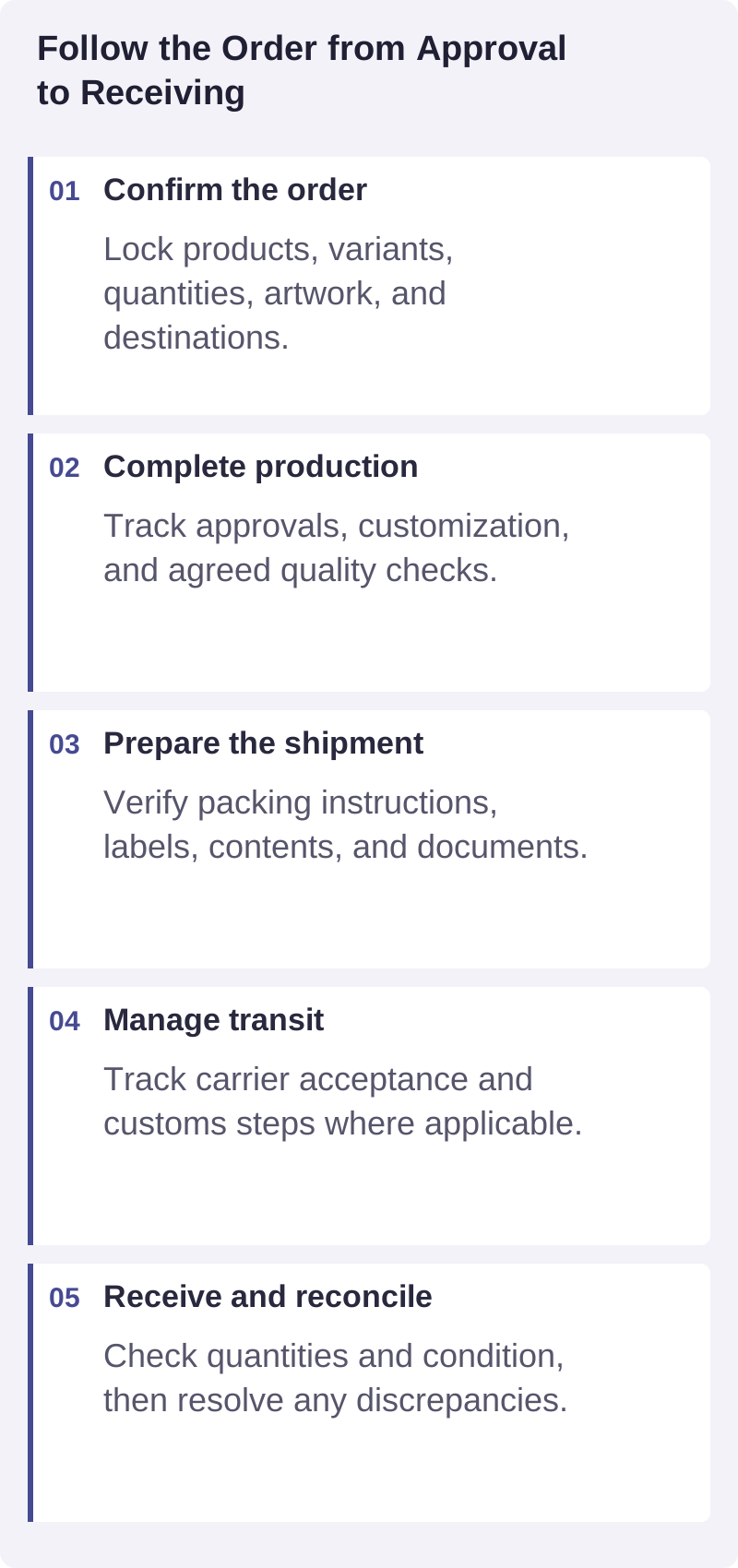
A practical visual summary of the decisions discussed in this guide.
Frequently asked questions
Does a shipping estimate include production time?
Not necessarily. Ask whether the quoted period starts at order approval, production completion, or carrier acceptance. Request a complete project schedule rather than adding assumptions to a single delivery estimate.
Can one order be sent to several addresses?
That depends on the agreed fulfillment service and destinations. Confirm recipient-data requirements, packaging, per-parcel costs, personalization controls, and exception handling before assuming a bulk quote covers individual dispatch.
What should happen if a parcel is delayed?
Check the last verified milestone and ask the responsible party for the next action. A production delay, carrier delay, and customs query require different responses. Communicate the facts without promising an unverified arrival date.
Need to scope a custom merchandise delivery plan? Contact Brilliantor with your products, quantities, destinations, packaging needs, and required arrival date.