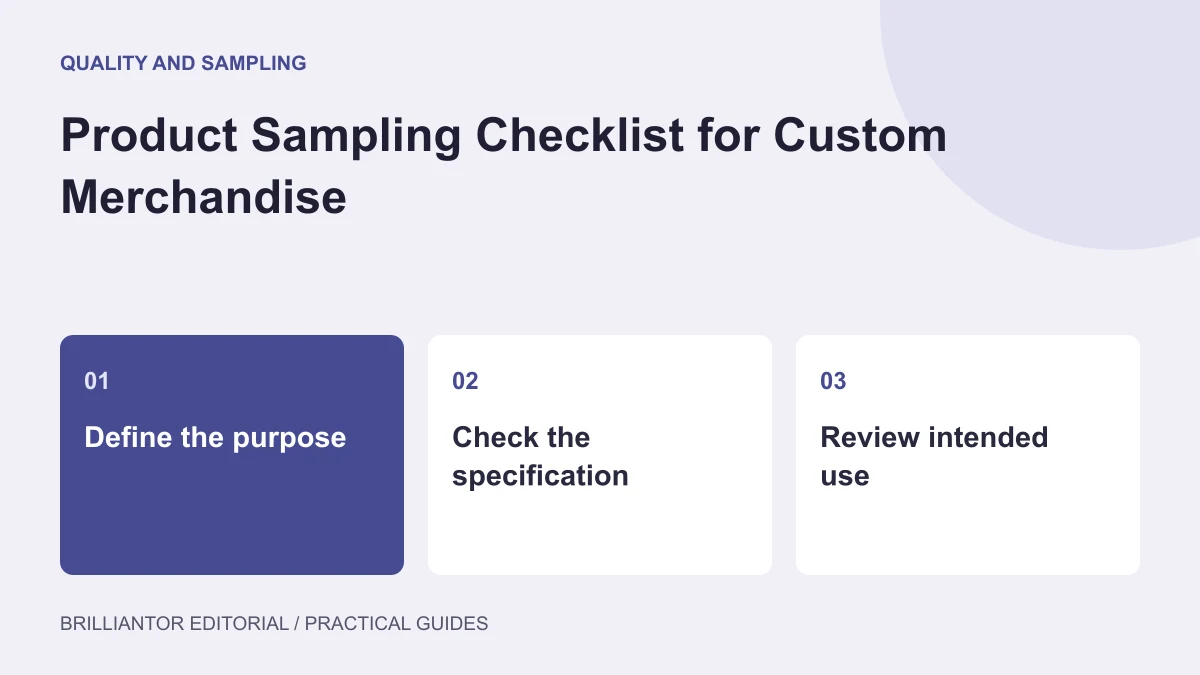
A custom product sample is most valuable when you know what decision it is supposed to support. A blank item can help you judge size and material. A decorated sample can show artwork execution. A production-representative sample may help you assess the intended finished result. None automatically answers every quality question.
Before requesting a sample, list what you need to learn and which details it will represent. This product sampling checklist helps buyers turn a subjective review into a clear, documented approval process.
Define the sample’s purpose and limits
Ask whether the sample uses the proposed materials, dimensions, color, decoration process, components, and packaging. If something differs, record the difference before reviewing it. Otherwise you may approve an attractive example that does not represent the quoted order.
Clarify whether it is a stock sample, a prototype, a pre-production sample, or an item taken from production. Labels can be used differently, so ask what the sample actually demonstrates rather than relying on the name.
For a coordinated gift set, review both the components and the assembled package. An individually acceptable item can still be unsuitable if it moves inside the box, obscures the note, or places pressure on another component.
Write the specification before judging quality
A specification makes your expectations observable. Include product references, materials where relevant, dimensions, colors, artwork version, print or decoration size, placement, components, and packaging requirements.
Agree on measurement methods and acceptable variation where necessary. “Centered” is not precise if one person measures from the seam and another from the visible panel. “Premium” cannot explain whether a zipper is operating correctly or a print has the required coverage.
Separate essential requirements from preferences
Identify details that must be correct, such as the approved name, product variant, functional closure, and required label. Distinguish these from preferences that may allow a practical compromise, such as a subtle surface texture.
Do not invent tolerances after seeing the result. If a visible difference matters to your brand, explain it early and ask how it can be checked consistently. If a requirement cannot be assessed from the sample, mark it as unresolved.
Inspect appearance under useful conditions
Start with a clean, well-lit workspace and the approved artwork at hand. Examine the item at normal viewing distance before looking closely. Both views matter: a small flaw might be prominent in use, while an enlarged photograph can make an insignificant texture look dramatic.
Check the logo shape, spelling, alignment, print boundaries, seams, surface finish, and consistency between visible components. Compare related items together. Record the lighting conditions when color is a critical decision, and avoid treating a phone screen as a definitive color reference.
Photograph any concern with a wider view for location and a closer view for detail. Include a ruler when showing dimensions. Describe the observable problem rather than writing only “bad quality.”
Test the intended use without overstating the result
A review should reflect the way the recipient will use the product. Put the expected contents in a bag, open and close a notebook, check how a lid fits, or compare garment measurements with the size specification.
For apparel, follow the stated care instructions when reviewing washing behavior. Record what you did and what changed. For packaging, check assembly, opening, product protection, and whether the contents remain organized during ordinary handling.
Use appropriate caution. Do not improvise hazardous electrical, chemical, heat, load, or food-contact testing. A casual use check can reveal a practical problem, but it does not establish a certified performance rating or replace qualified laboratory testing.
Review safety and compliance evidence separately
Appearance approval and regulatory compliance are different decisions. Ask which rules apply to the product, its intended users, and the destination. Confirm who is responsible for required testing, labeling, documentation, and any updates when materials or construction change.
For the United States, the Consumer Product Safety Commission explains that many consumer products require testing and certification. Its testing and certification guidance distinguishes requirements relevant to children’s products and general-use products. Review the actual product’s requirements with a qualified adviser rather than assuming one document covers every item.
If reports or certificates are provided, check their product identification, material or model scope, applicable standard, and issuing body. A document for a different item is not useful evidence simply because the products look similar. Keep compliance questions open until the responsible party has answered them.
Review packaging and identification
Inspect the packaging that will actually be used, not only presentation packaging shown in a mockup. Confirm that the product fits, protective materials stay in place, and opening the package does not damage the decoration.
Check unit labels, variant identification, carton markings, and any handling instructions. If several sizes look alike when folded, the receiving team needs a reliable way to distinguish them without opening every unit.
For textile products sold in the United States, consult the FTC’s clothing and textile guidance when reviewing required product information and care labeling. Decorative branding should not obscure information that needs to remain available.
Record a decision that production can follow
Use three clear outcomes: approved, revise and resubmit, or not approved. List each issue, its location, the requested correction, and how the correction will be verified. If conditional approval is necessary, make the remaining conditions explicit and state who can release production.
Keep the approved artwork version and sample reference together. Where practical, retain an approved physical sample so later comparisons use the same baseline. Record agreed exceptions rather than assuming everyone remembers a conversation.
Sample approval does not prove every production unit will match. Agree on the production inspection approach, defect handling, and the evidence you will receive before shipment. Do not choose an arbitrary inspection percentage and describe it as a universal quality standard.
Sample approval checklist
The sample’s purpose and non-representative details are documented.
Product, artwork, dimensions, and placement match the specification.
Relevant use checks are recorded with their limits.
Required compliance evidence is reviewed separately.
Packaging protects and clearly identifies each product variant.
Corrections and accepted exceptions are written down.
The approved reference and decision owner are identified.
Production inspection and defect handling are agreed.
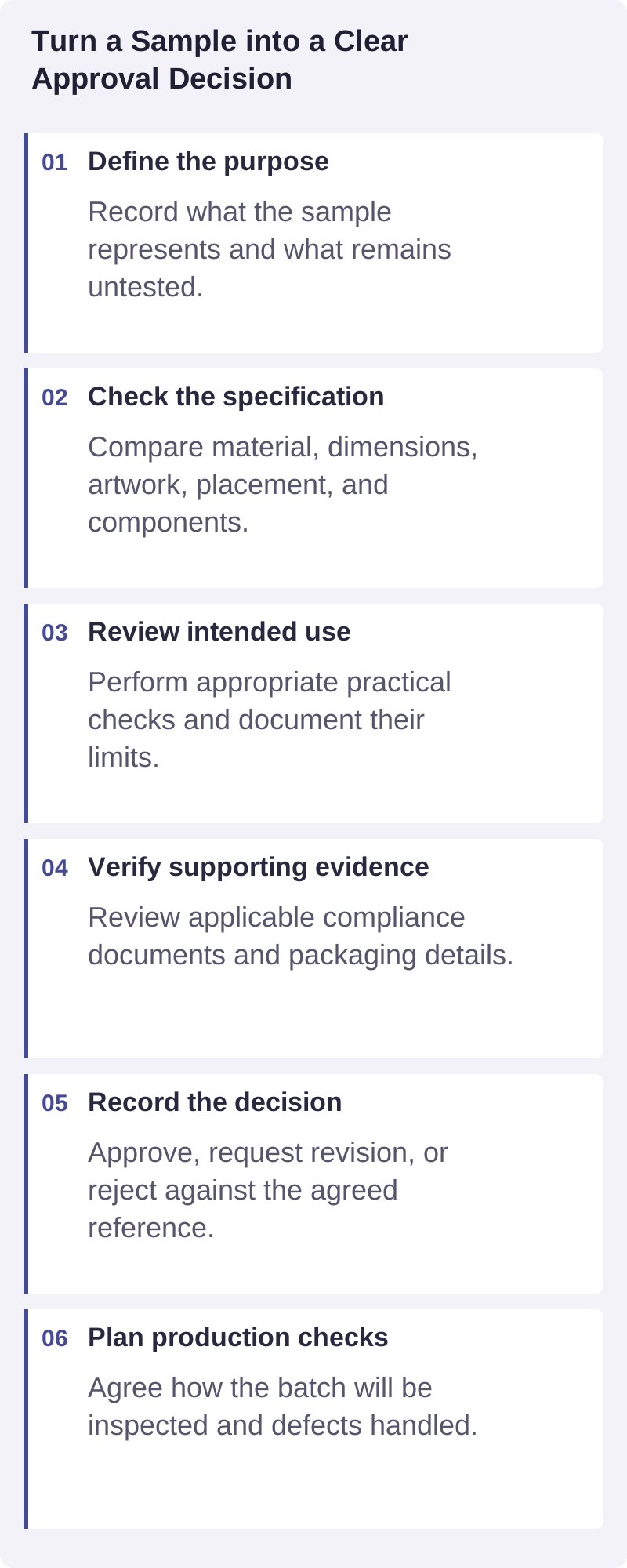
A practical visual summary of the decisions discussed in this guide.
Frequently asked questions
Is a digital mockup enough to approve production?
It can confirm composition and intended placement, but it cannot verify material feel, physical fit, decoration texture, or functional performance. Decide which risks require a physical sample before approving the order.
What if the sample is close but not quite right?
Describe the specific difference and request a correction or a clearly documented exception. Do not use an informal approval if the unresolved detail could materially affect the finished order.
Does an approved sample guarantee a perfect batch?
No. It establishes a reference for agreed attributes. Production controls, inspection, documentation, and a clear process for handling defects are still necessary parts of the buying plan.
Preparing to review a custom product? Contact Brilliantor with the product brief, intended use, destination, and the details you need the sample to demonstrate.