
Brilliantor Editorial · October 17, 2026 · 3 min read
Cotton Canvas vs All-Over-Print Totes: Compare the Construction
Compare two tote constructions, artwork coverage and practical dimensions. Define a useful bag brief without assuming every tote has the same capacity.
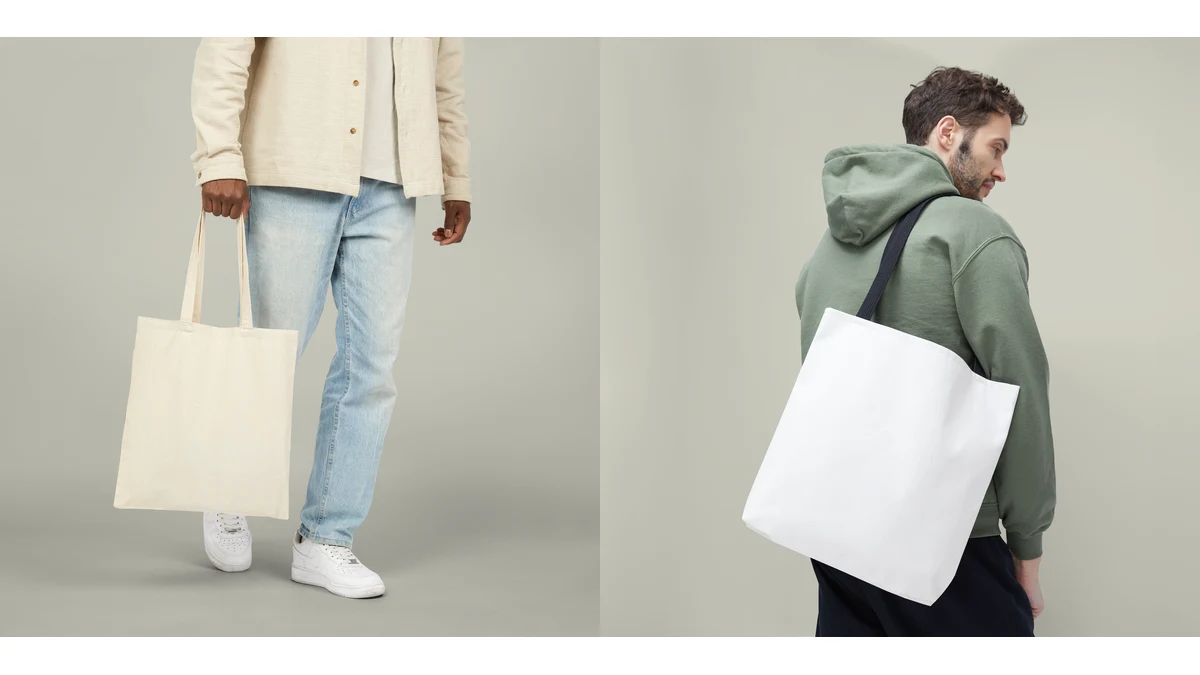
Two totes can share a familiar outline and still be different products. Fiber, lining, corner construction, handles and decoration all contribute to the result. Comparing only the front image can hide the details that matter during ordinary use.
This guide compares the specific cotton canvas tote and all-over-print tote in the catalog. It is not a claim that every cotton or polyester bag has the same specification.
Start with the construction record
The cotton canvas model lists a 100% cotton body, a nominal 15 by 16 inch size and flat-corner construction. Its reinforced handles are made from the bag fabric. The all-over-print model lists a polyester body, cotton webbing handles, a non-woven laminate lining and boxed corners. Read these as separate construction choices.
Do not compare their fabric-weight numbers as if they were capacity ratings. Material weight does not establish a tested carrying limit. If a project needs to carry a defined load, ask for appropriate evidence for the exact model instead of inventing a kilogram rating.
Describe what needs to fit
Write down the objects the bag is intended to hold, then check the relevant dimensions and opening. A folder, a folded garment and a bulky gift box do not use space in the same way. The nominal front-panel measurements alone may not answer whether the object fits comfortably.
For a team briefing, use a physical paper template or sample to test the intended arrangement. This is a planning aid, not a substitute for the supplier’s finished-product measurements. Keep room for the person’s hand and for inserting or removing the contents without forcing them.
Decide whether artwork is a placed graphic or a continuous composition
A placed emblem and an all-over repeat ask different questions. For a placed graphic, agree its scale and position against the visible bag panel. For an all-over composition, ask how the pattern behaves at seams, corners and any print boundaries.
Do not promise perfect continuity across stitched panels without a specific approved result. Move essential logos or faces away from uncertain transitions. Use a decorated sample when edge behavior is central to the design. Our brand-consistency guide can help separate identity rules from product-specific placement decisions.
Review handles, lining and care as separate decisions
The all-over-print model lists multiple handle-color options, but the exact choices need confirmation. Avoid building a color plan around an unnamed option count. Compare the handle treatment with the artwork after the available selection is known.
Read the selected model’s care instructions. Do not infer machine-wash suitability from the word cotton or assume a lining can be treated like the outer fabric. Keep the care statement attached to the final product record, particularly when multiple totes are presented in one collection.
Avoid unsupported environmental shortcuts
A material name alone does not establish that a bag is sustainable, recycled or better over its full life. This article makes no comparative environmental claim. If such a claim is important to the brief, identify the exact claim and evidence required before putting it on a product page.
Send a useful comparison brief
Include the intended contents, preferred construction, artwork coverage, handle preferences, quantity and destination. Ask which dimensions and options are confirmed for the quoted route. Choosing a tote then becomes a practical design decision, with the artwork fitted to the construction rather than the construction assumed from the artwork.